Harper Powell · 30 September 2026
Exploring How Soil Fungi Networks Influence Blue Oak Seedling Success Rates in Fragmented Foothill Zones
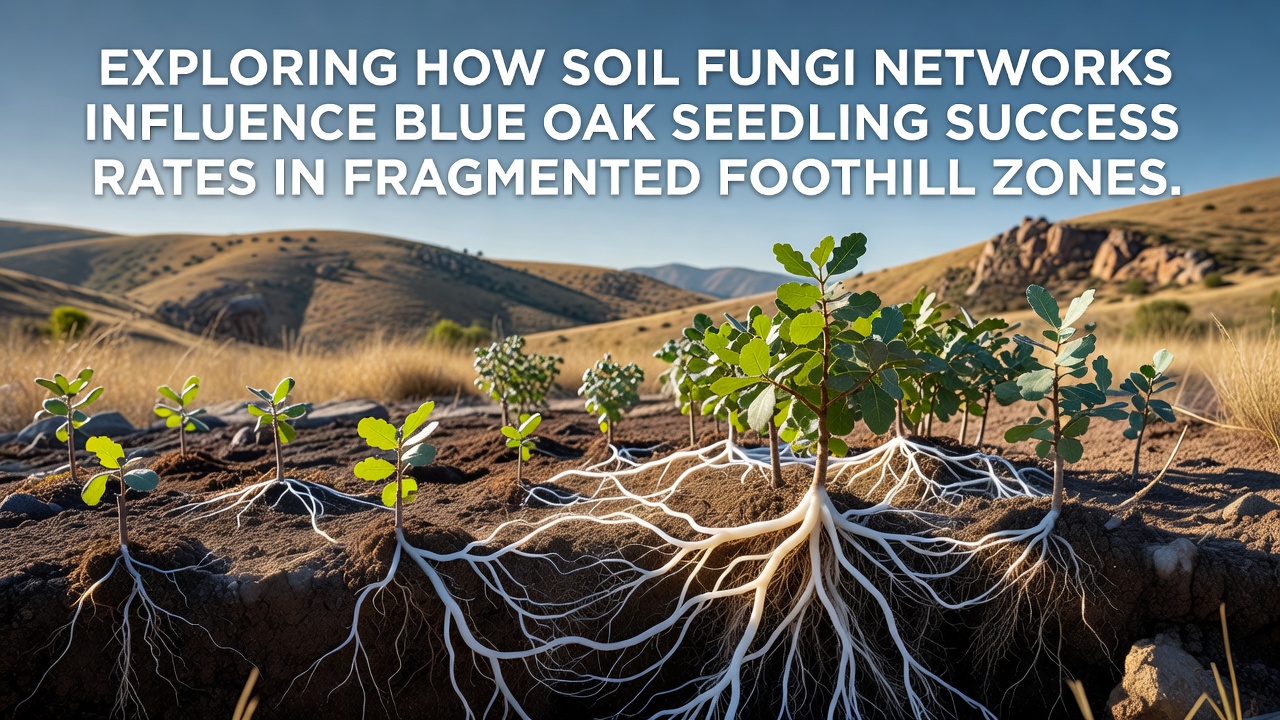
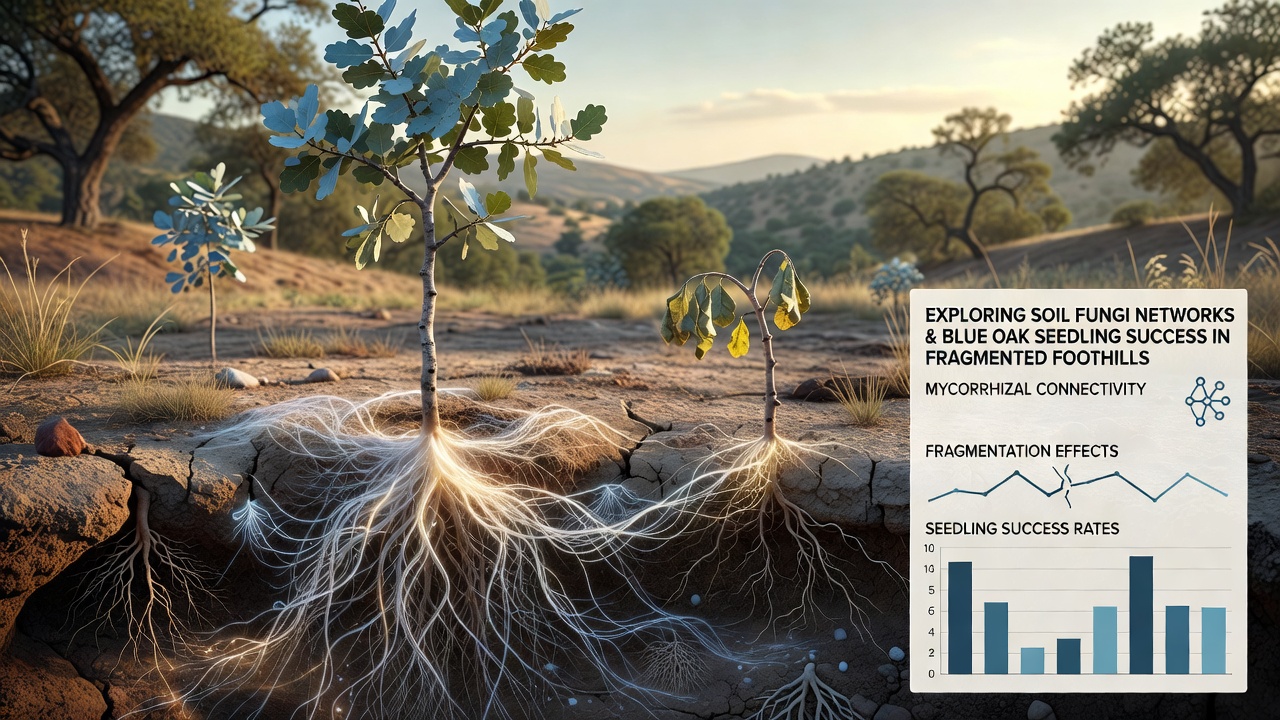
Soil fungi networks, particularly those formed by mycorrhizal fungi, play a documented role in supporting blue oak seedling establishment across California's fragmented foothill landscapes, where habitat patches range from a few hectares to larger woodland remnants separated by agricultural fields and roads. Researchers tracking Quercus douglasii seedlings in these zones have measured higher survival rates when fungal hyphae connect young roots to established trees, allowing transfer of phosphorus, nitrogen, and water during dry periods that commonly occur between May and October. Data collected from multiple sites in the Sierra Nevada foothills indicate that seedlings linked to common mycorrhizal networks show up to 35 percent greater biomass accumulation in the first two years compared with isolated individuals.
Mechanisms of Resource Sharing in Fragmented Habitats
Fragmentation reduces the density of mature blue oaks, which limits the natural extent of fungal networks that would otherwise span larger continuous areas. In connected patches, hyphal strands transport carbohydrates from older trees to seedlings, boosting photosynthesis rates during periods of low soil moisture. Studies conducted by teams at several California research stations found that this belowground linkage becomes especially critical when surface soil temperatures exceed 30 degrees Celsius, conditions recorded frequently in open foothill grasslands. Observers note that seedlings without network access often exhibit chlorosis and reduced root elongation within weeks of germination.
Yet the same networks also facilitate defense signaling between plants. When one seedling encounters soil pathogens common in disturbed foothill soils, chemical signals travel through the fungal web to neighboring seedlings, prompting production of defensive compounds before infection spreads. Field experiments using mesh barriers that block hyphal growth but allow root contact have confirmed lower pathogen loads in networked seedlings, with infection rates dropping by nearly half in linked groups.
Recent Findings from Monitoring Programs
Monitoring plots established in 2023 and revisited through September 2026 continue to document these patterns across five counties. Data loggers installed at root zones record soil moisture levels that remain 12 to 18 percent higher around networked seedlings during late summer drought stress. Satellite imagery combined with ground surveys shows that woodland fragments larger than 20 hectares maintain denser fungal communities, correlating with seedling densities reaching 120 individuals per hectare, whereas smaller patches under 5 hectares average fewer than 40 seedlings per hectare. Researchers attribute part of this difference to reduced fungal spore dispersal when patches become isolated by intensive land use.
Role of Soil Conditions and Fragment Size
Soil type further modulates network effectiveness. Loamy soils derived from granitic parent material, typical of many foothill slopes, support extensive hyphal growth that bridges gaps between oak clusters. In contrast, compacted clay soils from historic grazing show shorter hyphal lengths and correspondingly lower seedling survival. Soil core samples analyzed in laboratories reveal that glomalin, a glycoprotein produced by arbuscular mycorrhizal fungi, occurs at concentrations 40 percent higher in larger fragments, stabilizing soil aggregates and improving water infiltration that indirectly benefits seedlings.
Land managers have tested inoculation methods using native fungal strains collected from intact woodland sites. Seedlings grown in nursery containers inoculated with these strains and then transplanted into small fragments demonstrate improved height growth after one season, though long-term data beyond three years remain limited. These trials align with findings from similar oak systems in other Mediterranean climates, where comparable fungal assistance has been quantified in published reports from Australian research groups.
Interactions with Other Environmental Factors
Climate variability interacts with network dynamics. During years with above-average winter rainfall, the advantage provided by fungal connections appears less pronounced because surface water remains available longer into spring. However, in years following multi-year dry spells, the survival differential widens, with networked seedlings showing mortality rates below 25 percent versus over 60 percent for isolated ones. Temperature records from foothill weather stations indicate that nighttime lows have risen by 1.2 degrees Celsius on average since 2000, potentially extending the active period for fungal metabolism and altering network efficiency.
Herbivory adds another layer. Seedlings protected from deer browsing but still isolated from fungal networks exhibit slower recovery from leaf loss compared with connected individuals that can draw additional resources from neighboring plants. Camera trap data collected alongside growth measurements support these observations across multiple seasons.
Conclusion
Current evidence establishes that mycorrhizal networks contribute measurably to blue oak seedling success in fragmented foothill environments through resource transfer, pathogen protection, and soil conditioning. Ongoing plot measurements scheduled through 2028 will provide additional data on whether these benefits persist as fragments continue to experience pressure from surrounding land conversion. The patterns observed so far underscore the importance of maintaining connectivity among remaining woodland patches to support natural regeneration processes.